


Find coupons & more at BeFrugal.com!

|
Archive for the ‘Articles’ Category
Tuesday, September 28th, 2010

Catalinas coupons are one of my favorite topics because of their awesome savings potential. I’m often asked how to find catalina deals, and although there are multiple sources of information, this special type of checkout coupon is a recent innovation and as such, information can be thin on the ground at times. As I wrote in “Catalinas 101: What To Do If Your Coupon Doesn’t Print”, even the stores in which these offers print do not have the full details on their own catalina offers – most of the time, the only way you can get accurate information about catalina deals is to contact Catalina Marketing directly.
Well, it looks like Catalina Marketing may be taking the first step towards making their offers less confusing and more accessible to the general public. I read an article on Money Saving Mom this afternoon about a new website which they have launched, called CouponNetwork.com, where users can register to print coupons as well as access information about catalina offers (Or as they refer to them, “Buy & Save Offers”). Now, since this is a brand new website, information is very sparse: It only lists one catalina offer for my local store, so this isn’t a complete database by any stretch of the imagination. Also, I think this could be very confusing to most consumers, since you actually have to print the “Buy & Save Offer” in order to read the details of it – making it appear like a printable coupon, when in fact you’re just printing the information on how to earn a coupon. I think it would be a good idea to provide the details on the website without requiring the user to print it off just to read what the offer terms are. However, this is a brand new website and I’m sure they’ll continue to update it and make improvements – and I think it’s definitely worth bookmarking, as it has the potential to become a valuable resource for information in the future.
New to this website and wondering what on earth a “Catalina” is? Read my articles “Catalinas 101”, “How To Find Catalina Deals”, and “What To Do If Your Coupon Doesn’t Print” for more information!
Posted in Articles, Catalinas | 2 Comments »
Friday, May 14th, 2010
 One roadblock you may encounter when planning a meal around your stockpile is figuring out what exactly to do with all these ingredients. When you’re standing in front of your cupboard staring at cans, it can be hard to visualize what you could do with them. Here’s how I find inspiration for stockpile meals:
When I need meal ideas, the first place I turn to is Google. As an example, right now I have chicken thighs, carrots, and onions in my fridge. A quick search for “chicken thighs carrots onions recipe” brings up several yummy ideas, like Sweet-and-Sour Chicken Thighs with Carrots. But let’s say I’m in the mood for a different sort of dish, so I add “casserole” to the search query. This time, I get a chicken casserole recipe which I could adapt to what I have on hand.
Other times, my query might be a bit more general. Last summer I punched in “uses for leftover spaghetti” and ended up with this recipe for spaghetti pie. Google has helped me use up a lot of food that I had no clue what to do with!
- Check your favorite blogs:
There’s a lot of great websites devoted to pantry cooking that can help inspire your menu. Here’s a few of my recommendations:
Eat From Your Pantry
How to use those leftovers – an excellent article by Marjorie Burris on using what you have handy. A must-read!
Hot Coupon World’s Stockpile forum – includes a monthly “Living off your stockpile” challenge
Money Saving Mom’s Eat-From-The-Pantry-Challenge Link-up
I’m always curious to hear what my friends and family are cooking. If you’re out of ideas, ask someone else what they would make! Sometimes, I even take to social media outlets and brainstorm recipes with people through Twitter. (I’m @hardertobreathe if you ever want to say hi!)
- Don’t be afraid to experiment!
Some of my best dishes have come from pure experimentation. If you can’t find a recipe that works for you, why not make your own? When I have leftovers or ingredients that need to be used up, the first thing I think is: Could this be used in a casserole? Could I stir-fry it with something else? Would it be good in an omelet? Don’t be intimidated – experimenting could mean something as simple as swapping one ingredient for another. Worst comes to worst, it doesn’t turn out great and you’ve learned what substitutions don’t work. But you won’t know until you try – and you might discover a delicious new recipe!
Posted in Articles | 4 Comments »
Thursday, April 29th, 2010
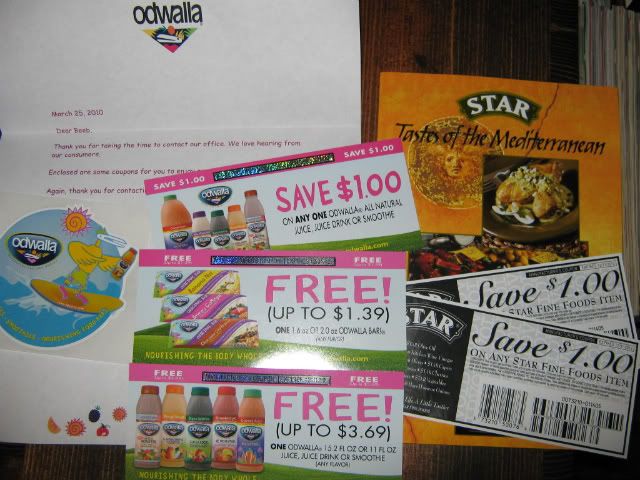
Today I’d like to discuss another easy way to save money and get coupons for items you use regularly – writing to the manufacturer directly.
If there is a product that I really find useful or enjoy, I will send an email to the company to let them know what I think of it. If I have a suggestion regarding a product I would like to see or a possible improvement, I will mention that as well. Companies greatly value feedback from their customers, and spend a lot of money researching what people want. As a result, they often send follow-up letters to thank me for getting in touch, and often they will enclose coupons as a thank-you.
Additionally, if there is a product that I am unfamiliar with and would like to try, I will drop the manufacturer a line to see if they have any coupon mailing lists that I can be added to.

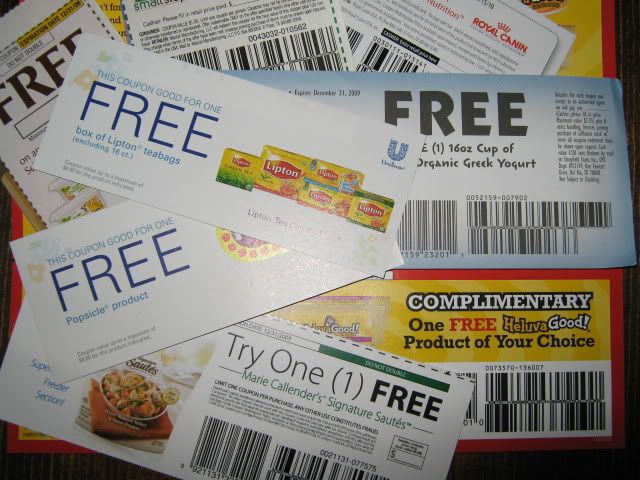
All it takes is a quick Google search to look up a company that you want to get in touch with and a minute to write a message. Most companies have contact forms directly on their website; there is even a list of such contact forms here. It doesn’t have to be a big time investment – the next time you’re writing emails, take an extra moment to send a note to a company that you like. In my experience, the small amount of time it takes to contact manufacturers has paid off with unusual, high-value coupons that I wouldn’t be able to find elsewhere – sometimes, I’ve even received free product coupons! Each photo in the post is of coupons I have received from manufacturers recently. As you can see, there are some fabulous coupons – even “frees” – for organic produce, sugar, and more.

Sometimes, a corporation will send something other than a coupon when you contact them. I recently wrote to a company to tell them that I enjoy their produce, and they mailed me a check for $5.00 marked “Customer appreciation” – you can imagine my surprise when that arrived! Other unusual items that I’ve received include a package of Kung Pao sauce and baseball caps.

But remember, companies have different promotions available at different times – just
because my neighbor writes to Brand X and gets a free coupon doesn’t mean that I will. When you contact a company, there is no guarantee that you will even receive a reply, let alone coupons; so don’t be disappointed if you don’t receive coupons from a specific company. Just by making the effort to put yourself out there as an interested consumer, you will find that brands frequently want to connect with you through promotions and special offers.
Companies love to hear what consumers think, and are often more than glad to forward their customers coupons to reward them for their loyalty and provide an incentive to purchase more products from them in the future. So don’t be afraid to express your interest – you might be surprised at what you find in your mailbox.
Posted in Articles | 3 Comments »
Tuesday, March 30th, 2010

Coupons I have received through trades this week
Today I’d like to talk about another way to build your coupon stash and increase your savings: By trading coupons. This could be as simple as swapping coupons with friends over coffee, or as advanced as exchanging envelopes of coupons with other coupon traders through the mail. If you’re new to using coupons, you’ll probably want to wait before diving head-first into trading – but if you’ve been using coupons for a while and feel ready to take it to the next level, then you may want to consider it. I’m going to explain how this works, what the benefits are, and how it’s helped me.
What is coupon trading and where does it take place?
Online coupon trading usually takes place on forums such as Hot Coupon World, which has a special forum just for this purpose. Members simply request to join the trading forum and can begin swapping coupons with other members – there is no fee to join or trade. Hot Coupon World’s trading forum includes an eBay-style trader rating system, so you can check feedback before trading coupons with others.
I know there are lots of other forums where you can trade coupons – this is just the only one I have personal experience with. (Feel free to share your favorites with me!)
How does it work?
Members post in the trading forum either with coupons they are searching for, or coupons that they have to trade. When you are interested in trading with another member, you send them a private message and work out the details of the trade.
For example, say Sally writes a post telling the trading forum that she has five coupons for .50/1 Brand X dish soap available. In return, she is looking for dog food coupons. Joan has dog food coupons and needs dish soap, so she send Sally a message telling her what she has and asking if she would like to trade. Sally agrees, so they swap addresses and mail coupons out to one another. After the trade is complete, they leave feedback for each other.
What people trade
You can trade “Coupon-for-coupon”, as in the example above; alternatively, some members prefer to charge a handling fee for their time clipping the coupons, or trade coupons for first-class stamps (Frequent coupon traders can go through a lot of postage!).
Can you really trust total strangers to come through with these trades?
Although Hot Coupon World has an excellent trader feedback system, you assume risk for all trades conducted. That being said, I have done well over 50 trades since joining Hot Coupon World, and I have never had a bad experience. Most of the people I have met through the online coupon community have been extremely nice, generous, and thoughtful. Most people I have traded with even included bonus “extra” coupons with my trade, just to be nice! Yes, there are some bad apples out there, but in my personal opinion the risk is not a big one. I’m willing to speculate the potential loss of a few coupons or stamps, since trading is a significant source of savings – and so far, that hasn’t happened.
What’s the point?
Coupon trading can be an excellent way to build up both your coupon stash and your stockpile. Let’s say that laundry detergent usually costs $5.00 at your store, and a $5/1 coupon comes out in the Sunday newspaper inserts. You spend a little time to trade for more $5 coupons, and snag a bunch of laundry detergent for the cost of stamps. Done right, trading can compliment your coupon usage and save you a lot of money. And this brings us to our next point:
Effective coupon trading
I traded a lot during 2008, when I was first learning the ropes of couponing. I stopped trading at the end of that summer, and didn’t start again until a week ago. The reason I stopped was because it was taking a lot of time and money, and after I discovered recycle bin diving, it seemed unnecessary. But as I went through my pantry last week, it occurred to me that many of the things in my stockpile were the result of trading – and had been a very worthwhile investment. Here is what I have learned:
Only trade for coupons you REALLY need. I got so caught up in trading in 2008 that I was trading for loads and loads of coupons. It wasn’t cost-effective, and I ended up swamped with coupons I didn’t need. Now, I am refining my focus to things that I definitely need – coupons that will get me something free or steeply discounted.
Trade stamps or a PayPal handling fee. When I was trading coupon-for-coupon, it took me ages to go through my coupon stash, figure out what others wanted, see what I could get rid of, clip, sort…it was not efficient at all, which is why I stopped. Now when I trade, I do stamps or PayPal only, unless I just happen to have a surplus of a coupon I don’t need that someone else can use – this makes trades quick and easy. Just factor the cost of the coupons in to your savings, and count it as part of your grocery budget. For example, if I trade a book of stamps for 30 free milk coupons, the milk is not “Free” – it cost me $8.80. But obviously, .29 cents for a gallon of milk would be a killer price, so this fictitious trade would be worthwhile. Just factor in your time and monetary investment, and make sure the result is worthwhile.
Allow for a learning curve! All that being said, using coupons is a learning process – and like all things, coupon trading has a learning curve. Don’t feel bad about the time it takes to learn the ropes; it will help you develop your savings strategy and save you money long-term.
If you’re ever on the Hot Coupon World forums, feel free to say hi – I’m “hardertobreathe” on there!
Readers, weigh in: Have you traded coupons before?
Posted in Articles | 11 Comments »
Monday, March 15th, 2010
 Don’t have time to use coupons? Well, if you could get free groceries in ten minutes – even if you know nothing about coupons – would you have the time for that? Then read on.
Many people are hesitant to start using coupons because of one thing: Time. Coupons seem overwhelming, and you don’t have the time to learn all that stuff and spend hours pinching pennies, right? But you don’t have to. Anyone can save money on their grocery bill immediately by taking a few minutes to read the following tips and click on a few links.
Step 1: Sign Up For Free Product Coupons Online
One effective advertising method that companies employ is offering limited-time free coupon offers on their websites. I love these offers, because it takes no more than 2 minutes to fill out a quick form and receive a free product coupon in return. I find out about these promotions by surfing my favorite frugal blogs, and then I write about these offers right here on Super Coupon Girl. Click on the “Free Coupons” link to go straight to that category and browse through the free offers – I post these links whenever I find them, so it is updated frequently.
Maybe you think these coupons will never arrive, or it’s “too good to be true”? Then I invite you to check out the following shopping trips where I have used coupons that I received from these type of offers. I have gotten free coffee creamer, free Always pads and Herbal Essences conditioner, free Starbucks ice cream, free Cascade rinse agent, free Dr. Pepper, and free clam chowder, free brownie mix, free candy bars, free hot dogs, and a free meatless vegetarian entree…I could go on, but you get the picture!
Step 2: Register For These Panels
Another way that advertisers spread the word about their products is by creating online panels that consumers can sign up for to receive coupon mailings. I am a member of the following websites, and consistently receive coupons in the mail for totally free products. The panels are free to sign up for, and require nothing on your part other than registering:
Vocalpoint
Pssst…Network
Thanks to these panels, I have received free Kashi cereal, free Rice Krispies, free frozen vegetables, and more.
Bonus Tip: Before you start signing up for coupons, I highly recommend setting up a free secondary email account with Gmail or Hotmail. Use this email address when you register for free offers, and you will keep your primary email free from getting cluttered with unwanted newsletters.
There are other ways to get free product coupons, which I will touch on in later articles; but I wanted to stick to these two tips for this particular post because they are effortless and require minimum time investment – so that truly anyone can start getting free groceries right away.
Posted in Articles | 26 Comments »
Tuesday, February 23rd, 2010
I’ve written about catalinas a few times previously, and I thought this topic was worth its own article. If you’re not sure what a “Catalina coupon” is, check out my articles “Catalinas 101” and “How To Find Catalina Deals”.
 Remember when I bought 6 tubes of Grands! biscuits because of a catalina deal, but my coupon didn’t print? Well, I sent Catalina Marketing an email, and they mailed the coupon to me. I spent $3.54 on the biscuits originally, and now that I’ve belatedly received my $4.00 coupon, I am .46 cents ahead!
Has this ever happened to you? You’ve found out about a great catalina deal, planned out your scenario, and are so excited about your savings – until you go through the checkout line and your coupon doesn’t print. Why does this happen, and what can you do about it?
Why Didn’t My Catalina Print?
Like any other electronic device, catalina machines are subject to malfunction. Modern cash registers are actually a regular PC hooked to a cash drawer – when you see your total being rung up on the screen, it’s taking place on a program running inside of Windows. And we all know that computers don’t always work the way they’re supposed to! But it’s not always a complex technical issue – sometimes, the catalina printer is simply out of paper.
And don’t forget human error: Sometimes, even the most savvy coupon-queen will buy the wrong item or quantity. The UPCs which trigger catalinas are very specific – so when possible, read the fine print and check the offer for exclusions. Do you have the right product, flavor, size? Is the promotion still running? For instance:
 This is the offer terms listed on my Pillsbury catalina. As an example, the Grands biscuits that I purchased were participating, but Toaster Strudels were not.
What Can I Do About It?
So your catalina didn’t print – now what? You have two options for rectifying the matter: Take it up at store level, or contact Catalina Marketing directly. I highly recommend that you take it up with Catalina Marketing, and here’s why. There are countless catalina promotions running at hundreds of stores across the country, and each promotion is tied to a specific list of product UPCs. In order for your local supermarket to be fully versed on the terms of each offer, they would need to have an extensive database listing all current catalina deals with UPCs and promo dates included.
Perhaps some stores do, but as far as I am aware, none in my area have any such list. In my experience, store staff often have no way of knowing which promotions are current; and if they do, they have no way of verifying the terms of the offer. Up until my last trip, I had never even bothered asking at store level about my catalinas. Last time, I decided that I would, just to see if it would be easier. First, I asked the cashier if the machine had paper, because my catalina had not printed and the lights on the machine were blinking in an odd manner. It did indeed have paper, so I then went to customer service and asked if there was something else wrong with the machine. The manager was aware of the Pillsbury deal, but she told me that she did not think the Grands! Jr. biscuits were participating, even though the offer didn’t specify any exclusions; so I told her I would email Catalina Marketing. I did – and they promptly sent me the coupon which should have printed.
Catalina Marketing are the company behind these coupons, and as such, they have quick access to anything you need to know about an offer. Every time I have contacted them, they have quickly determined what I should have received and mailed it to me directly. I have provided their email form and phone numbers at the bottom of this article – simply have your receipt ready when you contact them, and they will research the issue for you.
If it is vital that you receive your catalina during that shopping trip, you could ask a manager to return your items and re-ring them on another register. I’ve never done this, because in my experiences it would have been a big hassle for everyone.
Verifying Catalina Deals
I mentioned above that you should carefully check the terms of a catalina offer whenever possible – but sometimes, it isn’t. Say your sister calls and says, “Hey, I just got a $1.00 catalina for buying 3 Brand X canned vegetables at Safeway!”. So you stop by Safeway later that afternoon and buy 3 Brand X canned vegetables, but no catalina comes out. That’s your queue to email Catalina Marketing and say, “Hey, my sister got this great catalina for buying 3 Brand X canned vegetables, but I didn’t. Why is that?” You could even contact them before your shopping trip and ask for the terms of the offer. “My sister just told me about an offer for Brand X canned vegetables, can you tell me which varieties are participating?”
How to Contact Catalina Marketing
If you experience issues will a catalina not printing, you can click here to email Catalina Marketing or call them at either 1-877-210-1917 or 1-888-8coupon.
Posted in Articles, Catalinas | 8 Comments »
Saturday, September 12th, 2009
We talked earlier in the week about how to identify legitimate printable coupons, which brings me to another question I hear frequently: How do you know what stores will and won’t take Internet printable coupons?
Every store has its own coupon policy, and while some have a chain-wide coupon redemption policy, many grocers determine their own policies at store level – so your experience redeeming coupons can vary from location to location, even within the same chain. To find out what your local supermarket’s policies are, give them a call or stop by their customer service desk to inquire.
You may also be interested to check out this post on the “Hey, It’s Free” blog, which details the responses they received when writing to 34 companies regarding their printable coupon policy. A few months ago, Safeway released its first store-wide policy regarding printable coupons, which can be found on their website here. I was very disappointed to see how restrictive these new policies are – they will no longer accept Internet printables for free products, and they will not accept printable coupons for more than 50% of a product’s value, among other things. As a result, I haven’t used printable coupons at Safeway since this policy was posted. I’m guessing that these policies were implemented out of concern about coupon fraud – and while most high-value printable coupons are 100% legitimate, the higher the value, the higher the risk involved for the store if the coupon becomes compromised or turns out to be a fraud. But as time goes on, coupon printing technology will become more and more secure, and I hope that Safeway can update its policy to be less restrictive in the future.
Got a frugal question for Super Coupon Girl? Feel free to send me an email at supercoupongirl@gmail.com, and your question may be addressed in a future Q&A column.
Posted in Articles | No Comments »
Tuesday, September 8th, 2009
I get great emails from my readers, often asking questions on a variety of coupon topics. I always love to hear from you, and my readers pose excellent questions – so I thought it might be fun to start a Q&A column where I can share some of these questions and their answers. I was inspired to write this article based on a question I got a while ago from Christina of Saving 4 My Family – she wrote, “I have a question about IP’s. How do you know when you have a legitimate Internet coupon vs. a fraudulent one?”
This is a question I get frequently – how do you determine if Internet printable coupons (also known as printables or IPs) are legitimate? Printable coupons are a great way to save, and everyone I’ve had the pleasure of meeting in the coupon community have been ethical and conscientious. Unfortunately, printable coupons are still a target for fraud, and the actions of a few “bad apples” hurt everyone. So how can you be sure if the great coupon you found online is the real deal? Here are a few steps you can take to identify legitimate printables:
1. You can verify printables from Coupons.com by clicking here. This is a great resource for verifying any coupon printed using the Coupons.com software – simply enter the “Veri-Fi” code found on the front of each coupon, and it will instantly tell you if the coupon is valid or not.
2. When in doubt, ask. Hot Coupon World has a great forum titled “It’s Got To Be Real”, where they research the validity of coupons and post warnings about fraudulent ones. They contact manufacturers directly and verify all coupons that they post, so I find this to be an invaluable resource if I’m unsure about a coupon. Alternatively, you can contact the manufacturer directly to inquire about the coupon in question.
3. Use PDF and JPEG coupons with caution. Most printable coupons are printed via special software from Coupons.com or SmartSource.com. This software is designed to be fairly secure and prevent fraudulent activity. However, you will sometimes run across printable coupons in another format – sometimes as a downloadable PDF file, other times saved as an image file (.jpg, .gif, etc). This doesn’t automatically make the coupon invalid, but it does mean that you should proceed with caution, as these types of coupons usually allow unlimited prints and are more prone to fraud. Before using these coupons, I would always email the manufacturer or check Hot Coupon World to make sure that it is legitimate.
By keeping these points in mind, you can help to stamp out illegitimate coupons and do your part to ensure that coupon redemption continues to be a win-win situation for both consumers and manufacturers.
Got a frugal question for Super Coupon Girl? Feel free to send me an email at supercoupongirl@gmail.com, and your question may be addressed in a future Q&A column.
Posted in Articles | No Comments »
Thursday, September 3rd, 2009
 I am a guest poster over at Money Saving Mom today. My article is called “Five Strategies for Shopping Success”, and it outlines how I find the best deals by shopping at multiple stores, without wasting time or burning gas. Click here to read it!
If you’re a new visitor from Money Saving Mom, welcome! You might also enjoy checking out my “Coupon Articles” section.
Posted in Articles | No Comments »
|
|